

I recently interviewed Jennifer Ashton, author of “Physicks, Midwifes, Wise Women and Witches: The Role of Women in Medicine London: 1550–1640,” published in The Local Historian (November 2024).
Jennifer explained her approach to researching history for a scholarly publication:
“I was fortunate enough to be studying at Oxford when I researched for that paper and so had access to wonderful library resources. But when researching so far back in time it is imperative to look at many different sources from data sets and literature to art and even weather information, along with all of the sources you have mentioned. Every little piece of the puzzle added together paints a more complete picture.”
She also described the depth of her research into each of the women mentioned in the paper:
“For my paper specifically, I studied every one of the 110 women mentioned, every aspect of their lives that I could find, and only after I had researched all of the above, was I able to draw back to see their placement in the larger picture.”
Ashton emphasized how immersing herself in the details of each contemporary’s life allowed her to think deeply about the period:
“Studying history is more than just finding links though, it is about understanding what the time was like and immersing yourself fully into the time of your study. Knowing what was happening for example with immigration in the area, any illnesses, location (city centre or rural), legislation and other governing bodies (in my case the College of Physicians) will all add to the picture. Suffice to say it is not a short term project.”
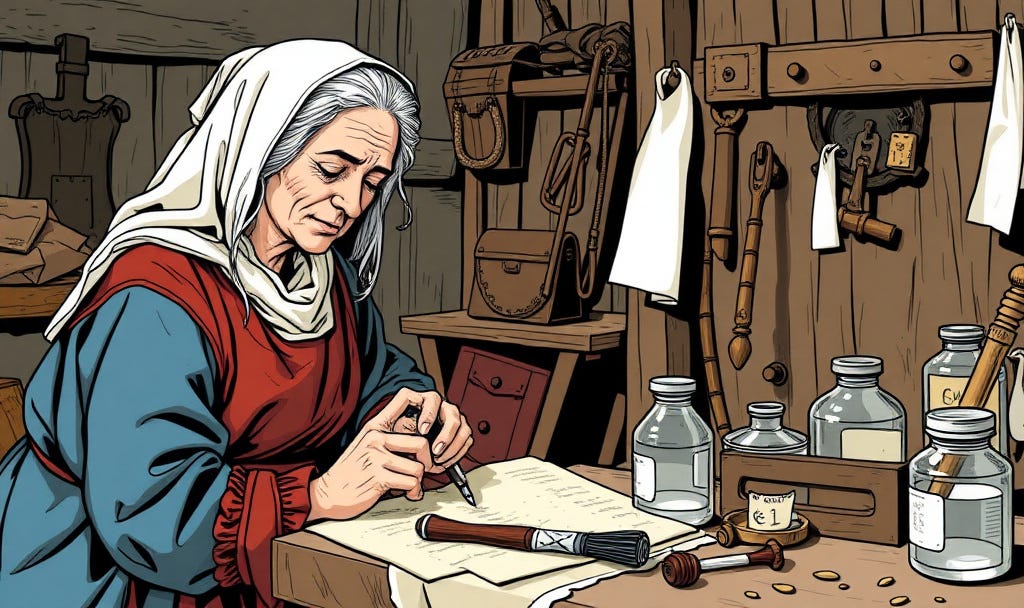
Immersion means recognizing that our conception of the past is often incomplete. Traveling back in time is like visiting a foreign country: the structures of life may be recognizable, but the forces that shaped daily existence are often quite different from what we understand today. Only by immersing ourselves in the history and culture of a period can we begin to interpret the data and facts meaningfully. Without immersion, context is lost.
This idea of immersion, as Ashton highlighted, lies at the heart of Neighbor History. Gathering facts and data in family history is valuable, but true understanding comes when we place ancestors among their neighbors, colleagues, or comrades. Only then do we begin to see them fully.
Ashton also reflected on her journey to publishing:
“I am a writer and author by profession so I am always interested in publishing, especially in the field of history if I find something that I feel should be shared. As this was initially a student project I only received guidance from my professor but of course had the friendship and support of my cohort. I think as a historian, we all need to work together, in a hopefully uniform way(!) to help each other’s work move forward, because it affects us all as we try to rebuild the past, where there are often many pieces missing. And it’s not just other historians, we must also have great relationships with Archivists, Librarians and others who are so important in the study and recovery of history.”
Her point is an important one: research does not have to be solitary. Building relationships with archivists, librarians, and fellow historians enriches the process and strengthens the work. Historical research is a journey best shared, not undertaken alone. This too is an important facet of Neighbor History; the research isn’t just a focus on researching the neighbors it’s about collaborating with others and creating content for a broad audience not just a family.
Even though Ashton’s paper was a final project, she noted that the research continues to hold value:
“This was the final paper for my school program, so it was not only the work that would demonstrate everything I had learned, but also showed where the work could be continued in the future (by me or other students). Everything I do helps me understand more, and I am sure that some of the research I found but didn’t use here will be helpful for something else down the road. I am interested in Early Modern medicine and underrepresented voices. Being interested in your research certainly helps in the often tedious work of archival research. As you move forward, you will always find more questions than answers, but that is the part of research that I love.”